What Is a Money Prompt? The High-Intent AI Query That Signals Revenue Opportunity
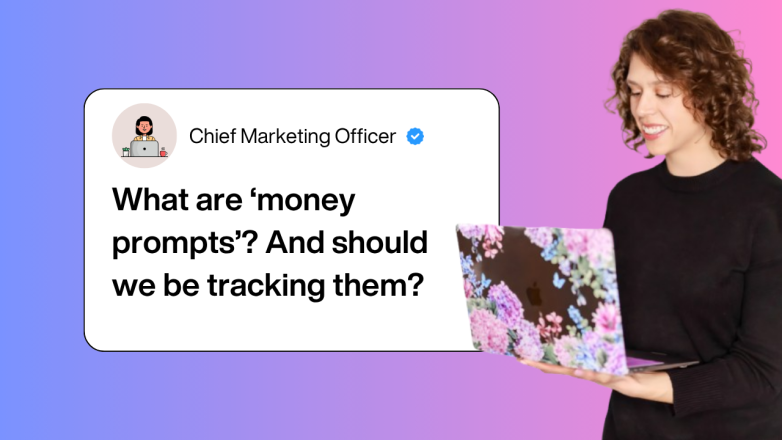
TL;DR: A money prompt is a high-commercial-intent query buyers use when they’re close to a decision—not researching, not browsing, but actively evaluating vendors, comparing solutions, or figuring out who to trust with their budget. In AI search, these are the prompts that shape shortlists before a sales conversation ever happens. If your brand isn’t showing up for them, you’re not losing rankings. You’re losing revenue influence.
What is a money prompt, exactly?
In AI search strategy, a money prompt is a query with a direct financial outcome attached—specifically, a buyer’s decision.
Money prompts are the questions people ask when money is actually on the line. Users enter these prompts when they’re evaluating vendors, comparing platforms, or figuring out which agency to hire or which tool to invest in. These are decision-stage queries, not curiosity queries.
And for B2B or B2C brands, it’s the only one that matters to your pipeline.
Why money prompts matter more in AI search than in traditional SEO
Buyers are no longer starting their research on Google and clicking through ten blue links. They’re opening ChatGPT, Perplexity, Gemini, and Google AI Mode and asking decision-stage questions. And they’re getting synthesized answers back without ever visiting a website.
That means the research phase of the buying journey is increasingly happening inside AI-generated answers. And if your brand isn’t showing up in those answers—specifically in the answers to high-intent prompts—you’re being excluded from consideration before a prospect ever reaches your site.
This is different from a rankings problem. AI engines pull from sources they trust, synthesize information into a response, and cite content that is fresh, clearly structured, and corroborated across the web. If your brand lacks those signals around high-intent topics, the engine won’t include you, regardless of your domain authority or keyword rankings.
Traditional SEO metrics won’t show you that gap. Only testing money prompts across AI engines will.
What makes a prompt a money prompt?
Not every search query is a money prompt. A money prompt has these characteristics:
- High commercial intent: the person asking is close to a decision, not just curious.
- Near-decision-stage behavior: they’re evaluating, comparing, or selecting, not learning.
- Vendor or category comparison implied: best,” “compare,” “top,” “alternatives to,” “vs.”
- ROI or implementation risk present: the answer has real business consequences.
- Solution selection, not casual exploration: they know the problem, and they’re choosing a solution.
Concrete examples of money prompts:
- “Best AI search optimization agency for B2B SaaS”
- “Compare [tool A] vs [tool B] for enterprise content teams”
- “Top fractional content strategist for funded startups”
- “What tool should we use for AI search visibility tracking?”
- “Alternatives to [existing platform] for mid-market SaaS”
- “Best AI visibility audit for enterprise marketing teams”
Notice what these prompts have in common: they’re specific, they’re comparative, and the person asking them is about to make a decision that costs money.
How are money prompts different from informational prompts?
Most content strategies are built around informational keywords. That made sense in a world where SEO meant ranking for “what is X” and “how does Y work.” But informational queries are awareness-stage, and they’re not where purchasing decisions get made.
Here’s a simple taxonomy that helps:
- Informational prompts: low commercial intent, awareness stage “What is AI search optimization?” The person is learning. They’re not buying anything yet.
- Research prompts: mid-funnel, evaluation beginning “How does AI search optimization work for SaaS companies?” The person is getting serious. They’re mapping the category.
- Money prompts: high intent, near-decision “Best AI search optimization consultant for B2B SaaS.” The person is building a shortlist. This prompt influences who gets a call.
Most content teams are publishing heavily for the first two categories and almost nothing for the third. Or, if they are publishing for the third group, they’re not specific enough to meet intent. That’s where the visibility gap is—and it’s costing brands pipeline influence they can’t see in their analytics.
What do money prompts look like across the buyer journey?
Even within high-intent queries, there are different flavors of money prompts, depending on where a buyer is in the decision process.
- Early evaluation: “What are the best platforms for [category]?” They’re framing the category and building a mental shortlist.
- Mid-funnel comparison: “[Brand A] vs [Brand B] for [specific use case]” They have a few options and need to differentiate.
- Late-stage decision: “Is [brand] right for a [company type] with [specific constraint]?” — They’re stress-testing a choice before committing. And they’re considering Implementation risk, pricing logic, and migration concerns.
For enterprise brands, there’s an additional layer: internal justification prompts. These are the queries a champion runs when they need to make the case to a CFO or a VP. “ROI of AI search optimization for enterprise content teams.” If your content doesn’t answer that prompt, you lose the deal at the internal approval stage, not the evaluation stage.
Why do some brands show up for money prompts while others don’t?
The reason some brands show up for money prompts while others don’t comes down to three signals that AI engines use to decide who to cite: Freshness, Structure, and Authority. These are the three pillars of the FSA Framework, and they’re particularly important when the stakes of a prompt are high.
Freshness means your content is current, regularly updated, and reflects your actual positioning. AI engines favor brands whose content signals are fresh and active. If your thought leadership is two years old and your service pages haven’t been touched, the model doesn’t have confidence that you’re still active in this category.
Structure means your content is organized in a way AI systems can parse, extract, and trust.
- Direct answers near the top of the page.
- Clear headings.
- Comparison language.
- Use-case specificity.
If a model can’t cleanly extract an answer from your content, it moves on.
Authority means other credible sources are confirming your brand’s expertise.
- Third-party mentions.
- Editorial citations.
- Consistent brand descriptors across the web.
- Expert signals attached to your content.
AI engines build trust from corroboration, not self-assertion. If your brand is only talking about itself on its own site, the model hedges.
The brands that show up for money prompts aren’t necessarily the biggest or the best-funded. They’re the ones whose content is fresh, structured for extraction, and corroborated by sources outside their own domain.
What are examples of money prompts in B2B SaaS and enterprise marketing?
Money prompts follow a specific formula, regardless of the industry. For the sake of an example, here’s how money prompts show up across different buying contexts for AI search optimization:
Software evaluation:
- “Best content intelligence platform for enterprise marketing teams”
- “Top AI search visibility tools for B2B SaaS”
- “What platform should we use for GEO and AEO?”
Service provider selection:
- “Best fractional content strategist for Series A startups”
- “Top AI search optimization agency for fintech brands”
- “Who should I hire to improve AI search visibility for an enterprise brand?”
Platform comparison:
- “[Tool A] vs [Tool B] for AI search visibility tracking”
- “Alternatives to [existing platform] for startup content teams”
Budget justification:
- “ROI of AI search optimization for B2B SaaS”
- “Cost of fractional content strategy vs full-time hire”
Implementation assessment:
- “How long does it take to improve AI search visibility?”
- “What team should own AI search optimization internally?”
If your brand has no presence in these prompt categories, your competitors are building shortlist authority without you knowing it.
TL;DR: How do you identify your brand’s real money prompts?
- Start with your revenue-critical use cases. What problems do you solve? What categories do you compete in? What buying situations lead to your product or service being considered?
- Pull language from sales calls and objection data. The questions your sales team hears in discovery calls are often money prompts in disguise. “How are you different from [competitor]?” and “Is this right for a company our size?” are decision-stage signals.
- Review comparison pages, analyst write-ups, and G2 reviews in your category. The language buyers use when evaluating you publicly is often exactly what they’re typing into AI engines.
- Generate prompt variants by persona, industry, and buying stage. A CMO at an enterprise brand prompts differently than a solo marketer at a Series A startup. Both matter. Build both lists.
- Test them. Open ChatGPT, Perplexity, Gemini, and Google AI Mode. Run the prompts. Document who gets cited, who doesn’t, and how your brand is described when it does appear.
- Track recommendation rate, not just mention rate. Appearing in an answer is one thing. Being recommended in the answer is another. The distinction matters for pipeline.
What should you measure when testing money prompts?
Before you optimize for anything, you need a baseline. Understanding your AI search visibility KPIs tells you where you actually stand in the prompts that drive decisions—not just whether you’re visible, but whether you’re visible where it counts.
Revenue is the metric that matters most. But these are the numbers that tell you whether you’re moving toward it:
- AI Share of Voice: How often does your brand appear across a defined set of money prompts?
- Recommendation rate: When you appear, are you being recommended or just mentioned?
- Citation frequency: Is your content being linked or named as a source?
- Competitor mention rate: Who’s appearing instead of you, and how often?
- Representation accuracy: When you do appear, is your brand described correctly?
- Use-case alignment: Are you being cited for the right use cases, or generic ones?
For enterprise teams, this connects directly to executive reporting:
- Pre-sales brand influence.
- Share of voice in buyer evaluation environments.
- Competitive positioning in decision-stage conversations.
The problem is this data doesn’t show up in Google Search Console or your SEO dashboard. It lives in the AI answers themselves, which means someone has to go look, or you purchase an AI search visibility tool to do the job for you.
What most teams get wrong about money prompts
Most content teams are measuring traffic, rankings, and engagement. Some are starting to track AI impressions through Bing Webmaster Tools or third-party dashboards. Almost none are running systematic money prompt tests across AI engines and asking, “Are we showing up where buying decisions are being made?”
Beyond that, here are the most common mistakes:
Focusing only on traffic keywords. Informational keywords drive volume. Money prompts drive influence. They’re not the same metric.
Ignoring comparison and alternatives content. AI engines are frequently asked comparison questions. If you have no content that takes a clear stance on how you compare to alternatives, you’re invisible at the most important moment.
Publishing educational content with no category stance. Generic “what is” and “how to” content won’t get you cited for money prompts. You need content that demonstrates judgment, specificity, and point of view.
Assuming rankings equal AI visibility. A page can rank in the top three for a keyword and still never appear in an AI-generated answer for the money prompt version of that topic.
Treating AI engines as one platform. ChatGPT, Perplexity, Gemini, and Google AI Mode have different retrieval behaviors. Your visibility is not portable. Test all of them.
Tracking hundreds of informational or research prompts. Those queries move buyers through the funnel, but they rarely surface your brand specifically, and volume without relevance just obscures the metrics that actually matter.
What should you do next?
The teams that identify their money prompt gaps now are the ones who build a defensible AI visibility position before their competitors realize what’s happening. Here’s how to start with your own money prompt audit:
Define your top 15–20 money prompts. These should be the specific queries buyers in your category use when they’re close to a decision — not the keywords your SEO tool says have the highest volume.
Test them across ChatGPT, Perplexity, Gemini, and Google AI Mode. Document who appears, how your brand is framed, and which competitors are being cited.
Ask: Are we present in the conversations that close deals?
If the answer is no—or if you’re not sure—that’s where to start.
If we haven’t met yet….
Hi, I’m Cassie, a fractional content strategist for startups and enterprise brands who focuses on AI search optimization.
If AI-generated answers are already influencing your buyers, your content strategy needs to account for that. I build content programs that connect strategy with execution: clear positioning, systems, and content that actually drive revenue. If you’re ready to stop guessing and start growing, here’s how we can work together.
Want more insights like this?
Subscribe to The Visibility Report, where I break down how AI engines interpret authority—and how you can show up in the results.
What is a money prompt?
A money prompt is a high-commercial-intent query buyers use when they’re close to a decision — evaluating vendors, comparing platforms, or choosing which tool or agency to invest in. These are decision-stage queries, not curiosity queries, and they’re the only ones that directly influence pipeline.
How are money prompts different from informational prompts?
Informational prompts are awareness-stage queries like “What is AI search optimization?” — the person is learning, not buying. Research prompts are mid-funnel, like “How does AI search optimization work for SaaS?” Money prompts are near-decision queries like “Best AI search optimization consultant for B2B SaaS” — the person is building a shortlist and deciding who gets a call.
Why do money prompts matter more in AI search than in traditional SEO?
Buyers are increasingly using ChatGPT, Perplexity, Gemini, and Google AI Mode to ask decision-stage questions and get synthesized answers — without ever visiting a website. If your brand isn’t showing up in those answers for high-intent prompts, you’re being excluded from consideration before a prospect ever reaches your site. Traditional SEO metrics won’t show you that gap.
What makes a prompt a money prompt?
A money prompt has five characteristics: high commercial intent, near-decision-stage behavior, vendor or category comparison language (best, compare, top, alternatives to, vs.), ROI or implementation risk implied, and solution selection rather than casual exploration. The person asking knows the problem — they’re choosing a solution.
How do you identify your brand’s real money prompts?
Start with your revenue-critical use cases, then pull language from sales calls and objection data. Review comparison pages, analyst write-ups, and G2 reviews in your category. Generate prompt variants by persona, industry, and buying stage. Then test them across ChatGPT, Perplexity, Gemini, and Google AI Mode — documenting who gets cited, who doesn’t, and how your brand is described.
What should you measure when testing money prompts?
Track AI Share of Voice (how often your brand appears across a defined set of money prompts), recommendation rate (are you being recommended or just mentioned), citation frequency, competitor mention rate, representation accuracy, and use-case alignment. This data lives in AI answers themselves — not in Google Search Console or your SEO dashboard.
What do most teams get wrong about money prompts?
The most common mistakes: focusing only on traffic keywords, ignoring comparison and alternatives content, publishing educational content with no category stance, assuming rankings equal AI visibility, treating all AI engines as one platform, and tracking hundreds of informational or research prompts that rarely surface your brand specifically.
Why do some brands show up for money prompts while others don’t?
It comes down to three signals: Freshness (current, regularly updated content that reflects your actual positioning), Structure (content organized so AI systems can parse, extract, and trust it), and Authority (third-party mentions and editorial citations that corroborate your expertise). These are the three pillars of the FSA Framework.