Google’s March 2026 Core Update Is Rewarding What AI Search Already Demands
TL;DR: Google’s March 2026 core update launched on March 27 with record-high volatility. Sites with original insights, well-structured content, and genuine expertise are holding or gaining. Sites relying on scaled AI-generated content without real added value are seeing traffic drop. The same signals the FSA Framework identifies for AI search visibility—freshness, structure, authority—are exactly what Google is rewarding.
Google’s March 2026 core update is live, and the volatility is real. But if you’ve been paying attention to how AI search engines choose their sources, none of what’s happening should surprise you.
The same signals that AI engines like ChatGPT, Perplexity, and Gemini use to decide which brands to cite? Google just turned the dial way up on all of them.
Here’s what the data shows, why original content is winning, and how the FSA Framework explains exactly what Google is rewarding right now.
What Is the Google March 2026 Core Update?
As of March 2026, Google has officially rolled out its first broad core update of the year. The rollout started on March 27 at 2:00 AM PT, and Google estimates it will take up to two weeks to complete.
Google’s stated goal is straightforward: surface relevant, satisfying content from all types of sites. Google has not offered a companion blog post or announced specific targets. Just a “surprise” rollout with very loud results.
How loud?
Semrush Sensor hit a volatility score of 9.4–9.5 out of 10 during peak rollout—one of the highest readings ever recorded. Early data shows that over half of monitored sites experienced measurable ranking changes within the first week.
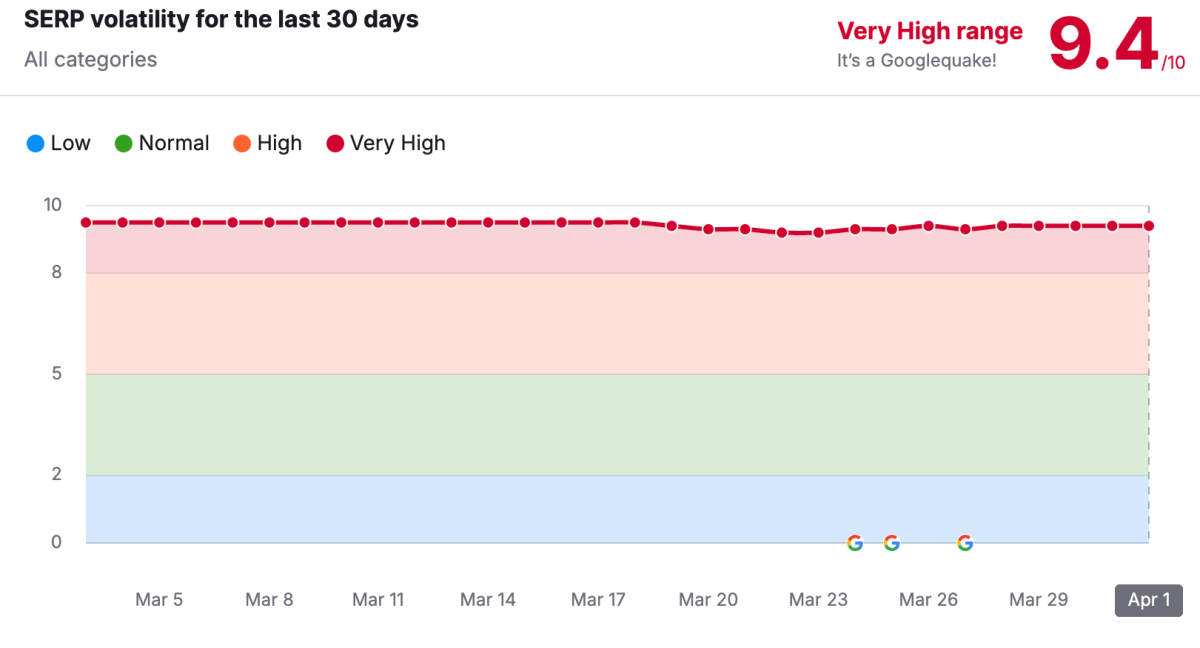
This core update landed just two days after the March 2026 spam update, which rolled out on March 24–25 and completed in under 20 hours—the fastest spam update in Google’s dashboard history.
That means Google cleaned house on spam first, then recalibrated quality signals for everyone else. These two separate updates, back to back, are hitting low-quality content from both directions simultaneously.
And before that? The February 2026 Discover-only core update ran from February 5 to February 27. That’s three algorithm changes in roughly five weeks. Talk about a shake-up.
Who’s Getting Hit—and Why?
The early data paints a clear picture of which sites are getting the hammer.
Sites seeing organic traffic drops share a common profile:
- Templated content, scaled production without original insight
- Thin AI-generated pages published without editorial oversight
- Affiliate comparison pages that don’t include proprietary data or first-hand testing
When Google’s algorithm measures how much genuinely new information a page contributes compared to what already ranks, volume without originality becomes a liability.
This matters for every content team: Google is now clearly measuring information gain.
The concept, which Google has patented and discussed in research papers, evaluates the delta between what your content says and what’s already available in the top results. If your page simply restates what a searcher could find elsewhere, the update pushes it down—regardless of how well it’s written or how strong the domain is.
Let me be clear here. This is not a blanket “AI content is bad” signal. It does shine a negative light, though, on “content that doesn’t add something unique.”
AI-assisted content with original data, expert perspective, and clear editorial judgment is performing just fine. The update targets how content is produced at scale without meaningful human contribution.
Sites that are holding or gaining share identifiable traits:
- Original research
- Proprietary data
- First-hand case studies
- Named expert commentary
- Specific methodology
- Genuine first-hand experience with the topics they cover
Why Does This Look Exactly Like What AI Search Engines Already Reward?
If you’ve been following what AI engines prioritize when choosing which brands to cite in generated answers, the March 2026 core update reads like a checklist of the same quality signals.
The FSA Framework—Freshness, Structure, Authority—was built to explain why AI engines like ChatGPT, Perplexity, and Gemini select certain brands and ignore others. It provides a predictable, repeatable process for increasing AI search visibility. And the overlap with what Google just rewarded is impossible to ignore.
Freshness
AI engines favor content that demonstrates active maintenance. A page looks alive with:
- Updated timestamps
- Revised explanations
- Current data
- Recent examples
Google’s March 2026 core update is doing the same thing. Pages with stale data are losing ground. Pages that include current context, updated statistics, and timely examples are holding or gaining.
If you’ve been applying FSA freshness signals to your content—adding “as of 2026” context, updating data points, refreshing case studies—you’re already ahead.
Structure
AI models don’t regurgitate entire blog posts. They break concepts into extractable chunks:
- Definitions
- Steps
- Direct answers
- Comparisons
The easier your content is for an AI engine to parse and lift cleanly, the more likely it is to be cited.
Google is now applying the same logic more aggressively. Well-organized content with clear, scannable formatting is outperforming long-form walls of text that bury the answer.
The FSA Framework’s structure principle—making content machine-readable so engines can extract it cleanly—is exactly what Google is now rewarding at scale.
(And this makes sense for Gemini and the AI Overviews, doesn’t it?)
Authority
In the FSA Framework, authority doesn’t mean domain authority in the traditional backlink-driven sense. It means entity authority:
- Whether a brand exists beyond its own website
- Whether it’s referenced across multiple platforms
- Whether it consistently reinforces its expertise across surfaces
Google’s core update is amplifying the same signals:
- Named authors with real credentials
- Expert commentary that can’t be replicated
- Original data. Specific methodology
- First-hand experience
E-E-A-T signals aren’t just tiebreakers anymore—they’re primary ranking factors.
The brands that invested in entity building are the ones that survived this update with the least damage. Authority compounds, and it compounds in both Google and AI engines.
Bottom line: Google and AI search engines are converging on the same quality signals. The content that survives a core update is increasingly the same content that gets cited in an AI-generated answer.
What Should You Do Right Now? (Not Panic-Publish)
The instinct after a core update is to produce more content. Resist that instinct because the lesson from every site that lost traffic in this update is not “we didn’t publish enough.” It’s “what we published didn’t add enough.”
Here’s what to do instead.
Audit what you have.
Open your affected pages alongside the top three ranking competitors for the same query.
Ask:
- Does this page contribute something genuinely new?
- Does it offer an original data point, a first-hand case study, a specific methodology, or a perspective nobody else has published?
If you can’t identify at least two or three unique elements, that page needs substantive work.
Prioritize refreshing high-value pages.
Don’t start with new content. Start with the pages that already drive pipeline or rank for high-intent terms. Update them with:
- Original data or case study results that only your brand has access to
- Freshness markers—current dates, recent examples, updated statistics
- Clearer structure—question-based H2s, direct answers placed before the explanation, labeled sections that engines can extract cleanly
- Stronger authority signals—named sources, specific methodology, links to supporting research
Strengthen internal linking.
The more connections you build between related concepts on your site, the stronger your semantic map becomes.
AI engines and Google both crawl these relationships to assess topical authority. Link your content pillars to hub pages and related subtopics.
Don’t chase the algorithm. Chase the standard.
The brands winning in this update aren’t chasing Google-specific tactics. They’re building content that meets a quality standard recognized by both Google and AI engines.
Focus on information gain, entity authority, and structural clarity—and the algorithm follows.
How Does the Spam Update Fit In?
The March 2026 spam update (March 24–25) targeted scaled content abuse, expired domain manipulation, and thin affiliate content. It completed in under 20 hours—a speed that tells you Google’s SpamBrain system knew exactly what it was looking for.
Combined with the core update two days later, Google is hitting low-quality content from both directions simultaneously. The spam update removes the worst offenders. The core update recalibrates quality signals for everyone else.
The combined signal is clear: the bar for content quality is rising across the board, not just in one dimension.
Pro tip: If your site experienced two distinct ranking drops in March, diagnose each update independently—the causes and fixes may be different.
What This Means for AI Search Visibility
If your content survived or gained in this core update, it’s likely well-positioned for AI search visibility, too. The quality signals Google is rewarding—originality, structure, expertise, freshness—are the same signals AI engines use to decide which brands to cite.
If your content dropped, it’s a signal that AI engines may also be overlooking your brand. A page that doesn’t pass Google’s information gain threshold probably isn’t differentiated enough for ChatGPT or Perplexity to confidently reference, either.
Use this update as a forcing function. If you haven’t run an AI visibility audit yet, now is the time:
- Check where your brand appears (or doesn’t) across AI engines.
- Look at which queries surface your competitors instead of you.
- Compare what you find to the pages that moved in this core update.
The convergence between Google’s quality signals and AI search visibility is accelerating. And the March 2026 data confirms what the FSA framework has been saying: freshness, structure, and authority aren’t just AI visibility tactics. They’re the content quality standard.
The brands that build for both will be the ones that stay visible. Everywhere.
If we haven’t met yet….
Hi, I’m Cassie, a fractional content strategist for startups and enterprise brands.
If AI-generated answers are already influencing your buyers, your content strategy needs to account for that. I build content programs that connect strategy with execution: clear positioning, systems, and content that actually drive revenue.
If you’re ready to stop guessing and start growing, here’s how we can work together.
Want more insights like this? Subscribe to The Visibility Report, where I break down how AI engines interpret authority — and how you can show up in the results.
What is the Google March 2026 core update?
The Google March 2026 core update is the first broad core update of 2026. It began rolling out on March 27 at 2:00 AM PT, with an estimated two-week completion window. Google described it as a regular update designed to surface relevant, satisfying content from all types of sites. Semrush Sensor volatility peaked at 9.4–9.5 out of 10 during rollout, and over 55% of monitored sites experienced measurable ranking changes.
Is the March 2026 core update a penalty for AI-generated content?
No. The March 2026 core update does not penalize AI-generated content outright. It targets content that lacks original insight, regardless of how it was produced. AI-assisted content with original data, expert perspective, and genuine editorial judgment is performing well. The update penalizes scaled content production—whether human or AI—that doesn’t contribute something unique compared to what already ranks.
What is information gain and why does it matter for this update?
Information gain measures how much genuinely new knowledge your content adds compared to the pages that already rank for the same query. Google has patented this concept and increased its weighting in the March 2026 core update. Pages that restate existing information without adding original data, first-hand experience, or unique perspectives are losing ground. A single original data point or case study is now more valuable than paragraphs of rewritten competitor content.
How does the FSA Framework connect to the March 2026 core update?
The FSA Framework—Freshness, Structure, Authority—was built to explain why AI engines cite certain brands and ignore others. The March 2026 core update is rewarding the same three signals: freshness (updated content with current data outperforms stale pages), structure (well-organized, question-based content is easier for Google and AI engines to parse), and authority (original expertise, named sources, and entity-level presence outperform generic content). This convergence confirms that optimizing for AI search visibility and surviving Google core updates now require the same quality signals.
What’s the difference between the March 2026 spam update and the core update?
They are separate algorithm changes. The March 2026 spam update rolled out on March 24–25 and completed in under 20 hours, targeting scaled content abuse, expired domain manipulation, and thin affiliate content. The core update began on March 27 and recalibrates quality signals across the web. If your site experienced two distinct ranking drops in March, diagnose and recover from each update independently—the causes and fixes are different.
What should I do if my traffic dropped after the March 2026 core update?
Don’t panic-publish new content. Instead, audit what you already have. Compare your affected pages against the top three competitors for the same queries and ask whether your content contributes something genuinely unique—original data, a first-hand case study, a specific methodology. Prioritize refreshing high-value pages with freshness markers, clearer structure, and stronger authority signals. Google recommends waiting at least one full week after the rollout completes before analyzing performance in Search Console.
If my content survived this update, does that mean it’s also positioned for AI search?
Likely, yes. The quality signals Google is rewarding in this update—originality, structured content, genuine expertise, and freshness—are the same signals AI engines like ChatGPT, Perplexity, and Gemini use when deciding which brands to cite. If your content held or gained during the March 2026 core update, it’s a strong indicator that your content is also well-positioned for AI search citation. If it dropped, consider running an AI visibility audit to check whether AI engines are also overlooking your brand.
How long will the March 2026 core update take to complete?
Google estimated up to two weeks. Based on the December 2025 core update, which took 18 days, expect full stabilization by mid-April 2026. Rankings may continue to shift throughout the rollout, and some early volatility may reverse naturally as the update settles. Avoid making major changes to your site until the rollout is confirmed complete on Google’s Search Status Dashboard.