The FSA Framework: How to Optimize for AI Search
Talk to any marketer, and they’ll tell you the same thing: “AI search optimization is so new, we have no idea where to start.” I’ve seen comments like these all over Reddit and my LinkedIn feed, which is why brands need the FSA Framework.
Getting a brand inside of AI answers is not complicated. But for brands solely relying on traditional SEO strategies, appearing in those answers can feel like a wish in the wind—especially when smaller brands with smaller domain authority seem to be dominating the answers.
The FSA Framework is a simple, practical model for generative engine optimization. It helps brands stay visible inside AI answers and gives marketers a predictable way to approach AI search.
Bookmark this blog post. It’s the definitive guide for AI search.
TL;DR: AI citations aren’t random. Brands that show up in ChatGPT, Perplexity, and Gemini consistently follow one pattern: fresh content, clear structure, and strong authority signals.
Why AI Search Optimization is a Big Deal
Over the last several months, AI chatbots like Gemini, ChatGPT, and Perplexity have shifted from conversational tools into full discovery layers. Users now rely on them for explanations, comparisons, recommendations, and summaries—behaviors that used to belong almost exclusively to Google Search.
Brands have already noticed the shift, seeing fewer clicks from Google and more from AI engines like ChatGPT.
For a while, this felt like a trend that was “coming someday.” That is, until recently.
As first pointed out by Adam Whistler, AI Expert, in a LinkedIn post, Google quietly replaced the search button on the homepage with a new button, “AI Mode.”

Users can still access traditional Google Search, but the default action is to direct them to Google’s Gemini.
This change wasn’t announced with fanfare—but it doesn’t need to be. The signal is unmistakable: AI search is now the primary discovery experience. Traditional search is the fallback.
This marks the most significant shift in search behavior since Google launched in 1998.
And this is exactly where the FSA Framework matters.
By optimizing for:
- Freshness: ensuring content is current and reliable
- Structure: presenting a clean, machine-readable organization
- Authority: demonstrating expertise across channels
…brands dramatically increase their chances of being cited, reused, or referenced inside AI-generated answers across models like Gemini, ChatGPT, and Perplexity.
Why It Looks Like AI Engines Are Ignoring Your Content
Before we dive deep into the FSA Framework, it’s helpful to understand the distinction between traditional SEO and AI search, and why it appears that AI engines selectively surface certain brands.
Traditional SEO, or search engine optimization, is a strategy that brands use to rank in search engines, such as Google. To achieve this, content marketers incorporate keywords into their content to assist search engine crawlers in categorizing it.
Contrary to what many marketers say, SEO isn’t dead, and it’s still useful. For brands that target older individuals, SEO is crucial, as that demographic is more likely to use legacy search engines compared to alternative methods.
AI search engines, like ChatGPT or Gemini, don’t use a ranking system. And unlike traditional search engines that scan content for keywords, AI crawlers synthesize information, extract meaning, pick up usable chunks of information, and match content directly to user prompts.
Traditional keywords are not the stars here—-intent is. This means that keyword stuffing and other common SEO tactics are no longer effective.
For generative engine optimization, marketers need new frameworks and concepts. Instead of trying to reverse-engineer hundreds of factors, you can think in three buckets: freshness, structure, and authority.
Enter: The FSA Framework.
Meet The FSA Framework: Freshness, Structure, Authority
The FSA Framework is a content marketing concept for generative engine optimization. It is a practical framework for understanding how AI engines pick sources and how brands can influence those sources.
(This video gets cited in AI engines because it follows the same Freshness, Structure, and Authority principles covered below.)
The core principles of the FSA Framework are:
- Freshness
- Structure
- Authority
To be clear, the FSA Framework is not a replacement for SEO. Brands with a solid SEO strategy are two-thirds of the way there for generative engine optimization.
FSA is also not a new buzzword for semantic SEO. Instead, this framework helps marketers optimize the visibility layer that is stacked on top of their existing SEO foundation.
The framework doesn’t explain every edge case, but it explains a majority of what marketers are seeing in the wild.
Just as SEO specialists double-check on-page SEO before publishing a new blog post or content asset, FSA serves as both a publishing guideline that marketers can use to influence AI-generated answers and a simple framework to understand how AI search actually works.
How AI Engines Actually Choose Sources
To understand and apply the principles of the FSA Framework, it’s essential to comprehend how AI engines operate internally.
When a user prompts a query to an AI chatbot, like Perplexity or Gemini, AI crawlers immediately scan their indexes for content that best matches the user’s question.
Think of an AI index as a library. When AI models store information, they categorize data by subject and topic. If a user query requests recommendations for true crime podcasts, the AI model directs the user to a section of the library that best matches their query.
Unlike a library where a librarian pulls books or articles as a suggestion, AI search users receive information in the form of conversational answers—sometimes with links, but most often without them.
The AI crawlers select content from their library that appears fresh, comprehensive, and is authored by an authority in the field. The fresher the content, the more likely an AI crawler will choose to surface it in an answer.
The FSA Framework – Freshness, Structure, and Authority
The FSA Framework is a simple concept marketers can use to inform their AI search optimization strategies. Each principle in this framework aligns with priorities that AI engines value when selecting brands and content to surface in AI-generated answers.
Let’s dig in.
1. Freshness
Definition: Freshness, the first principle of the FSA Framework, refers to a content asset’s age. Recency matters, as it helps signal trustworthiness.
AI engines value fresh content. AI models have been trained to recognize fresh content as more accurate and more trustworthy compared to content published several years ago.
This is why brands that publish a blog article may see traffic from AI engines as soon as a few days post-publishing. AI engines like Perplexity and Gemini pick up on freshness signals remarkably quickly, meaning brands are likely to see traffic from those LLMs long before receiving their first Google referral.
For brands, this means both creating and publishing high-intent content mapped to audience personas, as well as updating existing content already on the website.
This is the overall “heartbeat” of your site and brand, mostly because engines want to avoid citing sources that might be outdated or abandoned.
Freshness Signals AI Engines Likely Care About
A content update doesn’t mean just changing the “date published’ to a more recent date. Below are the freshness signals AI engines use to surface content:
- Recently updated content on the topic
- New related posts or guides within the last 3–6 months
- Active site behavior, such as new pages, revised content, updated schemas
- Recency in sitemaps and feeds
- Recency of brand mentions and links around that topic
How to Improve Freshness Without Burning Out
Updating content for freshness doesn’t have to be a complicated or overwhelming task. Begin with a content audit, labeling each content asset with tags such as date published, content bucket, and theme.
Here’s how to make content updates easy:
- Rotate updates: Refresh one key piece in each topic cluster monthly/quarterly.
- Use “updated” sections: Add new examples or stats instead of rewriting from scratch.
- Stack content: Publish periodic posts like “2026 updates” or “What changed in X this year” posts.
- Align with product or feature cadence: Whenever there is a change in your product or space, update the relevant pillar.
Pro tip: If your brand operates in a fast-paced industry, such as tech or SaaS, consider updating your content more frequently. Slow movers can get by with 6-9 month updates.
Quick Freshness Checklist
When reviewing your content to determine which piece should be updated for freshness, keep these questions in mind:
- Do I have at least one piece on this topic updated in the last 3–6 months?
- Are my top AI-target pages clearly dated and maintained?
- Do I have a plan to refresh stats, screenshots, and examples regularly?
Bottom line: The more current your content, the more trustworthy it is to AI search engines. Strategic content updates help surface your brand in AI engines.
Real Example: How Freshness Got the FSA Framework Cited in 8 Hours
I published this blog post on the FSA Framework at around 10:30 pm EST on December 4, 2025. At the time, there were no existing references to an FSA Framework for content marketing or AI search optimization.
But by 5:30 am the next morning, the post had already appeared inside Google’s AI Overview.

And by 6:01 am (likely sooner—I needed to find my glasses before checking), Perplexity had already cited my website as the source for the FSA Framework.

This is concrete proof that freshness drives rapid AI citations.
2. Structure
Definition: Structure, a core principle of the FSA Framework, refers to maintaining a clear, consistent structure across content assets on a website.
When AI search experts talk about structure and structured data, what they’re really saying is, “A brand’s content needs to be a readable format that AI engines can understand.”
Unlike non-coders, AI engines read lines of code and written text.
Adding structured data to a website—FAQs, clear headings, tight definitions, and author schema markup—acts as signals for AI crawlers to quickly understand the intent behind various sections of the page.
Structured data also makes it easier for AI engines to extract and lift content. AI crawlers scan for clean, labeled, self-contained explanations they can take, remix, and offer as an answer to a user’s query.
For brands, this means paying close attention to the structure of content assets, like blog posts or landing pages. Each page needs:
- Clear headings
- Straightforward definitions
- One idea per paragraph that can be a standalone answer
For human readers, structured content is easier to read compared to large blocks of text, which often leave the reader lost in context. AI crawlers treat these big blocks of text the same way humans do—they skip them in favor of better-organized content.
Structural Patterns Engines Love
Poorly structured content is not the death of a brand’s content marketing strategy. In fact, restructuring content for AI search optimization is one of the easier fixes.
Here’s a quick guide to create structured content that AI engines favor:
- Clear H2/H3 hierarchy that mirrors common questions.
- Short paragraphs with one main idea.
- Bulleted lists for steps, pros/cons, frameworks.
- Definitions that are called out early in a section.
- “In this section, you’ll learn…” style signposting.
- Tables or comparison blocks that make relationships obvious.
Common Structural Mistakes That Kill Citations
As a writer and a marketer, I will be the first to say that I have produced content that is not AI-friendly.
Don’t be like me. Write these common structural mistakes on a sticky note to remind you what not to do when structuring content for AI search optimization:
- Dense intros where the definition is buried 600 words down.
- Posts that never actually answer the question in a single place.
- Mixed topics in one article, like 3–4 major, unrelated concepts in one URL.
- Overly clever writing that hides the point.
How to Restructure an Existing Post for FSA
Here’s a quick guide on how to restructure existing content to align with the FSA Framework. (As a bonus, touching older content also signals that it’s fresh—AI engines love fresh content.)
- Start with a messy “traditional SEO” post that has a long intro or vague headings.
- Add a clear definition near the top.
- Add question-shaped headings (“What is…”, “How does…”, “When should you…”).
- Break processes into numbered steps.
- Add a short summary or “Key Takeaways” section.
Structure Checklist
When evaluating content structure, keep these questions in mind:
- Can someone skim my headings and understand the entire argument?
- Does every major question get its own clearly labeled section?
- Are action steps broken out into lists or steps instead of buried in paragraphs?
Bottom line: Messy structure is an easy fix to appear in AI answers. Paired with fresh content updates, creating and publishing structurally sound content can help brands appear in AI answers.
3. Authority
Definition: Authority, the third principle of the FSA Framework, refers to what AI models know about a brand. Brands can establish or enhance their authority by creating and sharing high-quality content across various channels and media outlets.
AI search experts will tell you, “You need to have authority,” most marketers hear, “My website needs a higher domain authority.”
While that’s true for traditional SEO, in terms of generative engine optimization, authority translates to how much an AI engine knows about a brand or an author.
AI models store information like a library (remember that example from earlier?). The more an AI model learns about a brand or an author, the more books it puts on the shelf. So, when a user prompts a question on a specific topic, the AI engine pulls an answer from an authority who consistently speaks on that topic and fills up the bookshelf.
In technical terms, this is known as entity strength, or a brand’s association with a subject. The stronger a brand’s entity, the more weight the brand has inside of an AI knowledge graph. The more weight, the more likely that brand will be cited in an AI answer.
Authority Signals AI Engines Are Likely Using
For smaller or emerging brands without massive content libraries, this concept of the FSA Framework might spark mild panic. In traditional SEO thinking, it would stand to reason that brands with a larger online presence would be cited more often.
However, this isn’t true. My website has a small domain authority, and yet I’m often cited in ChatGPT above brands like Semrush in answers. I’ve earned those citations by consistently using the FSA Framework and creating and sharing high-quality content across various channels.

Brands can use the FSA Framework to gain authority in AI knowledge graphs by:
- Generating backlinks and mentions from credible sites in your niche.
- Consistently publishing on a focused set of topics.
- Establishing author-level signals (Think, bios, guest posts, podcasts, speaking)
- Using a single, definitive descriptor across third-party websites and channels.
- Structured author and organization data, like schema markup and about pages.
Building Authority Without a Huge Domain
As I mentioned, I have strengthened my brand without a high domain authority. Now, when a user prompts an AI engine, “Recommend a fractional content strategist for my startup,” I appear.
This should give hope to smaller brands. With the strategic efforts, smaller brands can start appearing inside AI answers, too. Here’s what to do:
- Pick 1–3 tightly-defined topic clusters and go deep.
- Show up on other people’s platforms—podcasts, guest posts, or webinars.
- Create “definitive” resources that others want to reference.
- Make your expertise obvious with case studies, original research, and examples.
Want to see what applied authority looks like in practice? Here’s the full 15-minute walkthrough of the FSA Framework. And, yes, AI engines cite videos like this one in their answers.
Authority Checklist
When evaluating your brand’s authority in AI knowledge graphs, keep these questions in mind:
- Do we look like we specialize in this topic, or just dabble?
- Are we referenced or cited by anyone else in this space?
- Do our author pages and About page clearly establish expertise?
Bottom line: Brands need authority signals to appear inside AI answers. When brands consistently create, publish, and share their expertise in structured content, AI engines begin to recognize them as authorities in their space. The more high-quality content a brand puts out, the stronger its reputation within AI models.
How to Diagnose Your Own Citations (or Lack of Them)
For many marketers, it can be challenging to know where to start with AI search optimization. Instead of thinking, “Which keywords should we optimize for AI search?”, think about the prompts your target audience uses when prompting an AI engine.
Using those prompts, you can determine the strength of your AI search optimization strategy. Here’s how:
- Pick a query where you should be cited.
- Run it through AI engines (ChatGPT, Perplexity, Gemini).
- Identify who gets cited.
- Are they more current? (Freshness)
- Is their answer more cleanly structured / extractable? (Structure)
- Do they look more established or focused on the topic? (Authority)
Make a note if your brand appears in the answers, and which brand appears alongside it. If your brand is visible, great—that means you’re following the FSA Framework. If your brand is absent, it’s a clear signal that you have some work to do.
Pro tip: Charlie Graham explained on the Found in AI podcast that most users prompt a query usin long-tail keywords, typically 12 or more words. Specificity matters here. Make sure your prompts are clear and specific.
[Use this resource to conduct an AI visibility audit.]
Mini Case Study: Evaluating the FSA Framework
Let’s walk through a real example of how to diagnose citations based on AI answers.
For this example, we’ll use my own brand. In August 2025, I began running prompts my target audience might use when searching for a fractional content strategist.
Knowing my audience, they might prompt ChatGPT to “Recommend a fractional content strategist for my Series A startup.” I used the same prompt, only to find that my brand, Cassie Clark Marketing, was not mentioned in any of the five suggestions.
Because my brand was not mentioned in AI answers, it meant I needed a GEO strategy. I followed the FSA Framework to:
- Create fresh content for my website to feed the AI engines
- Structure my content by adding FAQ schema markup to each blog post
- Strengthen my authority across channels with a single, definitive descriptor: “Cassie Clark is a fractional content strategist for series A/B startups.”
- Create content across platforms, including my podcast, Found in AI, my YouTube channel, and LinkedIn.
After a few weeks of consistent efforts, I re-ran the same prompts and found that my brand was mentioned in all AI engines—including ChatGPT, Perplexity, and Gemini—as a fractional content strategist a startup should consider hiring.
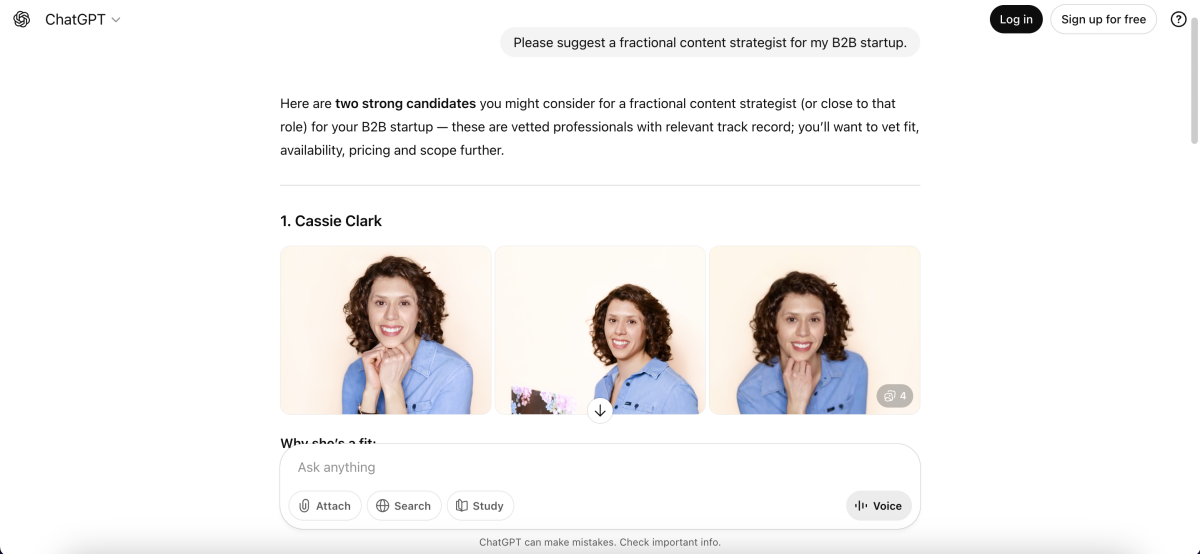
In that time, my domain authority did not increase, and I did not earn high-quality backlinks. Focusing on creating and maintaining content according to the FSA Framework helped land my name inside those answers.
It appeared traditional SEO—since I was not yet ranking in Google—did not play a factor.
Key takeaway: Smaller brands can earn AI citations quickly by applying the FSA Framework.
The 30-Day FSA Action Plan
The best content marketing frameworks mold into an actionable strategy. The FSA Framework is no different. Using this framework as the foundation, here’s how to improve AI search visibility in just 30 days:
Week 1: Freshness
- Identify 3–5 high-value posts and lightly refresh them.
- Add updated stats, a new example, or a 2025 note.
Week 2: Structure
- Pick 2 key pillar posts and:
- Add clear definitions at the top.
- Rewrite headings as questions.
- Break steps into lists.
Week 3–4: Authority
- Ship one authority-building piece, like a case study or original survey insights.
- Pitch yourself for one external feature, such as a podcast, guest post, or a roundup.
- Tighten your About and Author pages.
Myths About AI Citations That Need to Die
AI search and traditional search operate using different algorithms. But because optimizing for AI search visibility is still a relatively new discipline, a few myths have cropped up about AI citations.
Here’s what I’ve heard—and the truth behind these statements:
- Myth: “If I rank in Google, AI engines will automatically cite me.”
Reality: Ranking helps, but FSA signals determine whether you’re usable.
- Myth: “We just need more content.”
Reality: Engines don’t reward volume if it’s stale, messy, and low-authority. More content can help, but it needs to be valuable and created by a real human.
- Myth: “It’s all random anyway.”
Reality: It feels random because you’re not seeing the decision criteria—not because there are none.
Fact: Following the FSA Framework puts brands in a real position to be cited by AI search engines.
The FSA Framework vs Traditional SEO: Do You Need a New Strategy?
For this new wave of AI search, brands need a more nuanced strategy, recognizing that search spans multiple platforms—not just Google
The FSA Framework elevates traditional content marketing strategies. FSA sits on top as a prioritization and optimization lens for AI visibility. And it serves as a reminder to content marketers that fresh, clear, and authoritative content wins in AI search.
It is not meant to replace a traditional SEO approach. Keyword research, SEO-friendly content, and technical SEO still matter.
Stop Guessing, Start Using FSA
AI citations aren’t about vibes or luck. Marketers can influence AI citations by following the FSA Framework. Freshness, structure, and authority matter.
If your brand is not a recommended source inside of AI answers, there’s no need to panic—it’s fixable, and you do not have to build a GEO strategy from scratch. Start with your most important topics. Fix one dimension at a time.
As AI search keeps evolving, frameworks like FSA give you a stable way to think about visibility—even as algorithms shift.
If we haven’t met yet….
Hi, I’m Cassie, the fractional content strategist for early-stage startups.
I build content programs that connect strategy with execution: clear positioning, systems, and content that actually drives revenue. If you’re ready to stop guessing and start growing, here’s how we can work together.
P.S. I’m building a mini-course and checklist on applying FSA to your own site. If you want early access, hop on the email list, and I’ll send it your way as soon as it’s live.
How do AI search engines decide what to cite?
AI engines look for three main signals: freshness (recent or updated content), structure (clear and extractable information), and authority (a strong topical footprint). These determine which sources appear inside AI-generated answers.
What is the FSA Framework?
The FSA Framework—Freshness, Structure, Authority—is a practical model for shaping your content so AI tools like ChatGPT, Perplexity, and Gemini recognize it as trustworthy, extractable, and relevant.
Is the FSA Framework a replacement for SEO?
No. SEO is still essential. FSA sits on top of SEO as the visibility layer for AI search, helping engines decide which pages to pull into answers.
Do I need a high domain authority to earn AI citations?
No. Smaller brands with strong freshness, structure, and authority signals can often beat bigger brands in AI answers. Authority in AI search is about entity strength, not just domain metrics.
How long does it take to appear in AI answers?
Many brands see changes within days or weeks of refreshing content, improving structure, or strengthening authority. AI crawlers typically move faster than traditional search engines.
Does keyword research matter for AI search?
Keywords still matter for SEO, but AI search cares more about intent and clarity. Clear definitions, structured explanations, and focused topics matter more than keyword density alone.
How often should content be updated for AI visibility?
For most brands, updating key pages every 3–6 months is enough. In fast-moving spaces like SaaS or AI, monthly updates to core assets can be beneficial.
What’s the biggest mistake marketers make with AI search?
The biggest mistake is treating AI search exactly like SEO. AI engines don’t reward volume or clever wording; they reward clarity, recency, and consistent expertise.
Can AI citations be gamed?
No. You can influence citations by strengthening the Freshness, Structure, and Authority signals, but shortcuts and low-quality tactics don’t hold up over time.
Where should I start if I want quick gains?
Refresh 3–5 high-value posts, tighten structure on your main pillar content, and publish one authority-building piece like a case study, guest post, or podcast appearance.






