Found in AI Ep 48: Google’s March 2026 Core Update, the Reddit Visibility Myth, and What’s Coming at Cloud Next

Google’s March 2026 core update is one of the most volatile updates in recent memory, and it’s telling us exactly where search is headed. In this episode of Found in AI, I break down what the data is showing, who’s getting hit hardest, and why the signals Google just turned up map directly to how AI engines decide who gets cited.
I also dig into a Search Engine Land piece that challenges one of the most popular narratives in GEO: that brands need a Reddit and Wikipedia strategy to earn AI citations. The data tells a very different story. And I wrap with a preview of Google Cloud Next and what marketers should be watching as AI Mode in Search continues to expand.
Google’s March 2026 Core Update: What’s Happening and Why It Matters for AI Visibility
Google started rolling out the March 2026 core update on March 27th. It’s the first broad core update of 2026, and the volatility has been significant. Semrush Sensor hit 9.5 out of 10 during peak rollout—one of the highest scores ever recorded. Over 55% of tracked sites are showing major ranking movement, with some reporting traffic drops between 20 and 50 percent.
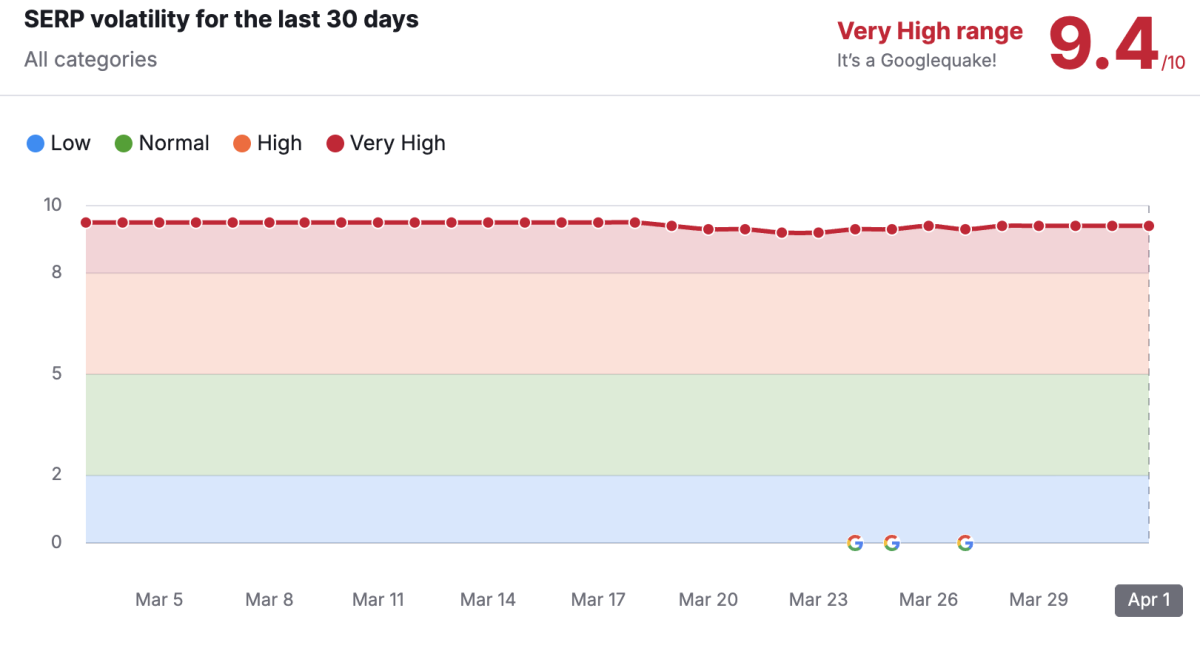
The update didn’t arrive alone. Google completed a spam update on March 24th–25th in under 20 hours—the shortest confirmed spam update in their dashboard history—before launching the core update two days later. The spam update cleared out bad actors. The core update recalibrated quality signals for everyone else.
Who’s Getting Hit
The patterns are consistent across the data:
- Generic, mass-produced content without unique value
- AI-generated content published at scale without expert oversight
- Blogs that repackage what’s already ranking without adding original insight
- Affiliate sites that compare products without conducting their own tests
- Programmatic SEO strategies built on templated pages
The “publish an article for every keyword” playbook is breaking down.
Who’s Winning
Pages with clear author credentials and first-person experience are gaining positions. Content that demonstrates genuine expertise—original data, case studies, proprietary insights—is outperforming content that simply summarizes the SERP. Sites with strong topical authority and depth in their niche are holding steady or climbing.
In other words, Google just tightened the dial on Experience and Authoritativeness—the same signals AI engines use to decide who gets cited.
The FSA Framework Connection
This is where the convergence matters.
When ChatGPT, Perplexity, or Google’s AI Overviews choose which source to reference in an answer, they’re evaluating the same quality signals Google just reinforced: clarity, authority, consistent expertise, and fresh, well-structured content from a trusted source.
That’s the FSA Framework—Freshness, Structure, Authority.
If you’ve been building entity authority, structuring your content for extractability, and keeping it fresh, this update shouldn’t feel like a crisis. It should feel like validation. The gap between “optimized for rankings” and “optimized for being trusted and cited” just got narrower.
Practical advice: Don’t panic. Don’t rewrite everything at once. Google recommends waiting at least a full week after the rollout completes before making major changes. Monitor what’s moving, document the shifts, and when things stabilize—likely mid-April—audit your content with one question: does this page add something genuinely new compared to the top five results for its target keyword?
The Reddit Visibility Myth: Why Chasing Reddit Won’t Win You AI Citations
Search Engine Land published a piece by Gaetano DiNardi last week titled “Stop chasing Reddit and Wikipedia: What actually drives AI recommendations.” It challenges the dominant GEO narrative that brands need a Reddit strategy to earn AI visibility.
The data is compelling.
Yes, Reddit and Wikipedia are the most-cited domains across LLMs in aggregate. But those macro studies analyze hundreds of thousands of randomized keywords across every topic imaginable. Reddit and Wikipedia have massive topical footprints. Of course they show up the most when you zoom out that far.
The problem is when brands take that aggregate data and pivot their entire GEO strategy toward seeding Reddit threads. The Reddit threads that actually get cited for high-intent queries represent years of authentic human discussion reaching genuine consensus. That can’t be manufactured in a few weeks by a marketing team.
The data that stood out most to me: 80% of Reddit threads cited by AI have fewer than 20 upvotes, and the average age of cited posts is around 900 days. This isn’t about Reddit virality. It’s about old, specific, authentic discussions that happened to be genuinely useful.
What Authority Actually Means
This reinforces the Authority pillar of the FSA Framework. Authority isn’t about being everywhere. It’s about being consistent in the right places — the specific digital neighborhood that influences your category.
Your website remains your most powerful asset. Your product pages, solution pages, and thought leadership are where AI engines go to understand what your brand actually does. Your off-page presence—podcast appearances, guest posts, digital PR, industry mentions—reinforces that signal.
If you’re spending GEO budget on agencies seeding Reddit threads, it’s worth reconsidering. That energy is better spent strengthening entity authority from your own properties and earning real mentions in the places your buyers trust.
That’s not to say Reddit can’t be a winning play, it can. Just be aware you might not see an immediate ROI with this strategy.
The core update story and the Reddit story point to the same conclusion: the signals are converging. Google is rewarding genuine authority. AI engines are citing genuine authority. Manufactured presence on someone else’s platform is not the path.
Google Cloud Next: What to Watch (April 22–24)
Google Cloud Next is happening later this month in Las Vegas. It’s Google’s biggest product announcement event of the year, and there are three things marketers should be tracking.
Gemini API updates. Google has been pushing the Gemini ecosystem hard. Cloud Next is where they typically announce what’s next for developers and enterprise customers.
AI Mode in Search. Google has been expanding AI Mode steadily. If it gets a broader rollout or new capabilities at Cloud Next, that directly affects how brands appear in AI-generated answers.
Agentic AI. AI agents that browse, research, shop, and take actions on behalf of users are accelerating across the industry. Microsoft just launched Critique and Copilot Cowork—both using multi-model architectures for enterprise research. The more agentic these systems become, the more critical it is that content is structured for machine interpretation.
I’ll be covering whatever comes out of Cloud Next as it happens. Subscribe to Found in AI so you don’t miss the breakdown.
Tying It Together
Three stories, one theme. Google’s core update is rewarding the same signals AI engines use to decide who gets cited. New data confirms that chasing Reddit for AI visibility is the wrong strategy for most brands. And Google Cloud Next could reshape the next phase of AI search.
The brands that stay visible in 2026 will be the ones whose expertise is clear, consistent, and authoritative enough that both traditional search and AI engines confidently reference them when it matters most.
If you want to know where your brand stands in AI search—especially after this core update—get started with an AI search visibility audit.
If we haven’t met yet….
Hi, I’m Cassie, a fractional content strategist for early-stage startups who focuses on AI search optimization.
If AI-generated answers are already influencing your buyers, your content strategy needs to account for that. I build content programs that connect strategy with execution: clear positioning, systems, and content that actually drive revenue. If you’re ready to stop guessing and start growing, here’s how we can work together.