AI Visibility Audit Case Study: Why Alai Wasn’t Showing Up in AI Answers

AI Visibility Audit Overview
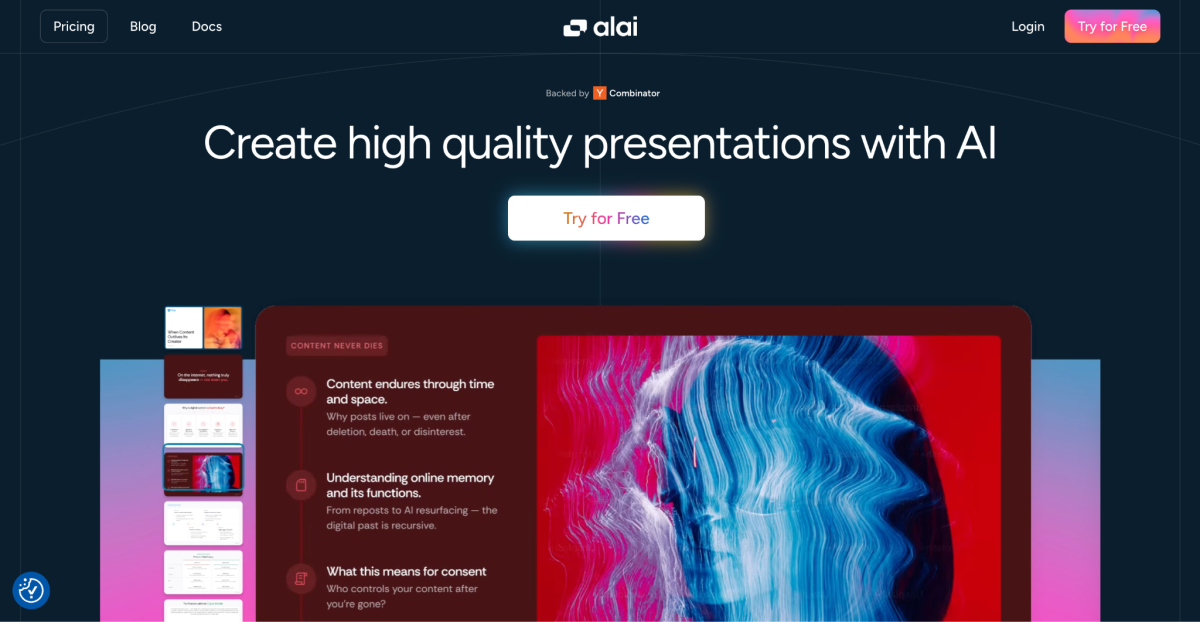
This case study breaks down an AI visibility audit I ran for Alai, an AI-powered presentation tool. The audit examined how AI systems interpret and recommend presentation software in response to users’ natural-language questions.
The audit focused on how AI systems decide what to recommend. I tested real prompts, reviewed which sources AI engines cited, and compared how competitors were described in AI-generated answers.
One pattern stood out quickly: clarity mattered more than authority. The tools that appeared most often were easy for AI systems to understand. It was clear who they were for and when they should be suggested.
Alai’s product and content fundamentals were strong. Yet when users asked AI models for presentation recommendations, other products appeared more often—including some with lower domain authority.
This AI visibility audit case study demonstrates how AI search and citations operate in practice—and why many brands continue to struggle to appear in AI-driven discovery.
The Problem: Why Alai Wasn’t Showing Up in AI Answers
Alai wasn’t invisible because the product was weak. On the surface, everything looked right. The site was clear, the product made sense, and the content covered the basics you’d expect in a competitive SaaS category.
However, when I tested real prompts in AI answer engines—such as “best AI presentation maker” or, more specifically, audience-based questions—Alai rarely appeared. Instead, AI engines consistently cited other tools, including some with lower domain authority and fewer traditional SEO signals.
That gap is what triggered the audit.
From a human perspective, Alai’s positioning worked. It was easy to understand what the product did.
From a machine perspective, the signal was fuzzier. The brand wasn’t clearly anchored to specific use cases, which made it harder for AI systems to confidently recommend it.
This is a pattern I’m seeing more often as discovery shifts toward AI-generated answers. Content that reads well to people doesn’t always translate cleanly to systems that rely on pattern recognition and clear associations.
The audit focused on two core questions: What were AI engines using to decide which presentation tools to trust? And, where was Alai falling out of that decision process?
What Is an AI Visibility Audit?
An AI visibility audit looks at how AI answer engines like ChatGPT, Gemini, and Perplexity interpret a brand when users ask real questions.
The goal of an AI visibility audit is to determine whether AI systems accurately identify the target audience for a product, the problem it solves, and when it should be recommended. That clarity determines whether a brand shows up in answers at all.
Instead of rankings or backlinks, the audit focuses on prompts, citations, and patterns. It examines which brands AI engines surface, how they describe them, and what signals seem to influence trust.
The output isn’t a list of technical fixes. It’s a clear picture of how AI systems currently understand a brand — and where that understanding breaks down.
What I Tested
I tested how LLMs surface and recommend presentation software in response to real user questions.
That meant running a range of natural-language prompts, from broad discovery queries to more specific, use-case-driven ones. For each prompt, I looked at which tools appeared in AI-generated answers, how they were described, and which sources were cited.
I also compared Alai’s positioning to competitors that showed up more often. This included reviewing how clearly each product communicated who it was for, what problem it solved, and how consistently that framing appeared beyond the website.
The goal of this AI visibility audit wasn’t to reverse-engineer AI systems. It was to identify repeatable patterns in what AI engines reward.
What I Found
Domain Authority Wasn’t the Deciding Factor
In traditional SEO, domain authority is often a strong predictor of visibility. In AI-generated answers, that pattern didn’t hold.
AI engines regularly cited competitors with lower domain authority when their content made it easier to understand who the product was for and when it should be recommended.
Clarity Beat Breadth
The presentation makers that appeared most frequently in AI answers were explicit about their intended use cases. Instead of trying to appeal to everyone who makes presentations, they clearly anchored themselves to specific audiences or scenarios.
Alai’s positioning made sense to human readers, but it was too broad for consistent machine interpretation.
Off-Site Signals Reinforced Trust
Competitors that appeared most frequently in AI answers also had a visible presence beyond their websites. Consistent language across blogs, social channels, and other public content helped AI systems form stronger associations between those brands and specific presentation needs.
These patterns suggest that AI visibility is less about raw authority metrics and more about how confidently a brand can be interpreted as the right answer for a specific question.
The 2 Priorities That Matter Most for AI Visibility
1. Be Explicit About Who the Product Is For
AI systems need specificity. The tools that showed up most often in AI answers made it obvious who they were built for and when they should be recommended. Broad positioning made it harder for AI engines to confidently match a product to a question. Clear use cases made that decision easier.
For Alai, this meant that while the messaging made sense to people, it didn’t give AI systems a strong enough signal about when the product was the right fit.
2. Reinforce That Positioning Beyond the Website
AI engines don’t rely on a single page or site. They look for consistent signals across the web. Competitors that appeared more often repeated the same positioning across blogs, social content, and other public channels.
Volume mattered less than consistency. When the same framing appeared in multiple places, AI systems formed stronger associations and trusted those brands more frequently.
Authority vs Domain Authority in AI Search
In traditional SEO, domain authority is often treated as a proxy for trust. Higher-authority sites tend to rank more easily.
AI search works differently.
When AI engines generate answers, authority is contextual. The question isn’t which site is strongest overall. It’s which source that seems most qualified to answer this specific question.
That’s why lower–domain authority sites can appear more often in AI answers. When a brand is clearly associated with a particular audience, use case, or problem—and that association shows up consistently across the web—AI systems are more confident recommending it.
In Alai’s case, the issue wasn’t credibility or product quality. It was that AI engines didn’t yet have strong enough signals tying the brand to specific presentation scenarios.
For AI visibility, authority is built through clarity and consistency. When a brand is easy to understand in context, AI systems trust it faster—regardless of domain authority.
What Success Looks Like After an AI Visibility Audit
Success isn’t about sudden ranking jumps or traffic spikes. It shows up as clearer, more consistent visibility in AI-generated answers.
When the audit insights and the FSA framework are put into practice, AI engines begin to associate the brand with specific use cases more reliably. Instead of appearing randomly—or not at all— the brand shows up when the question matches what the product does best.
Internally, success looks like focus. Teams stop guessing which messages matter and align around a small number of clear priorities. Positioning becomes more consistent, and distribution decisions are guided by how AI systems interpret and reinforce that story.
Over time, these signals compound. AI engines gain confidence, recommendations become more predictable, and visibility becomes something a brand can intentionally build.
Why This Case Study on AI Visibility Matters
AI-driven discovery is transforming how brands are discovered. Visibility is no longer just about rankings or domain authority. It’s shaped by how clearly a product can be understood in context.
Alai’s case reflects a pattern that many teams are encountering right now: strong products, solid content, and still inconsistent AI visibility. The gap isn’t effort. It’s how AI systems interpret and connect the signals a brand puts into the world.
An AI visibility audit helps surface that gap. It shows how a brand is currently being understood, where that understanding breaks down, and what needs to change for the brand to become an obvious answer when users ask real questions.
AI Visibility Audit FAQs
What is an AI visibility audit?
An AI visibility audit analyzes how AI systems like ChatGPT, Gemini, and Perplexity interpret and recommend a brand when users ask natural-language questions. It focuses on prompts, citations, and patterns in AI-generated answers.
How is an AI visibility audit different from an SEO audit?
An SEO audit evaluates how pages perform in traditional search engines. An AI visibility audit evaluates whether AI systems clearly understand who a product is for, what it does, and when it should be recommended in an answer.
Why doesn’t domain authority guarantee AI visibility?
AI systems prioritize contextual relevance and clarity over global authority metrics. Brands with lower domain authority can appear more often in AI answers when their use cases and positioning are easier to interpret and reuse.
What signals do AI engines use to recommend brands?
AI engines rely on clarity and consistent associations. That includes how a brand is described on its website, how it appears in cited sources, and how consistently the same positioning shows up across the web.
What kinds of questions does an AI visibility audit test?
An audit tests real discovery and evaluative prompts, including category queries, comparison questions, and audience-specific use cases. The goal is to see which brands appear, how they’re framed, and what sources are cited.
What does an AI visibility audit deliver?
An AI visibility audit delivers a diagnosis of how AI systems currently understand a brand. It highlights where that understanding breaks down and what to prioritize so the brand becomes a more “obvious” answer.
Who should get an AI visibility audit?
AI visibility audits are useful for SaaS companies and brands that rely on discovery and recommendations. They’re especially helpful when content exists but the brand still struggles to appear in AI-generated answers.
Does an AI visibility audit include implementation?
No. The audit is the diagnostic step. Implementation happens after, when recommendations are applied across key pages and reinforced through consistent messaging and distribution.
How long does it take to see changes after implementing recommendations?
Changes usually appear gradually as AI systems encounter clearer and more consistent signals. Improvements tend to compound over time as positioning and reinforcement build across multiple surfaces.
Is AI visibility replacing SEO?
AI visibility doesn’t replace SEO. Traditional SEO still matters, while AI visibility focuses on how brands are interpreted and recommended in AI-generated answers.
Need an AI Visibility Audit for your brand?
I’m a fractional content strategist specializing in AI visibility and AI-driven discovery. If you want to understand how AI systems interpret and recommend your product—and what to prioritize to improve that visibility—request an AI visibility audit below.